Press kit
Everything here is free to reuse, with attribution.
The definition in three lengths, the citation, the diagrams, and the receipts — including the audits where the standard’s own implementation failed. Verbatim use welcome.
Performed autonomy — the definition
Performed autonomy (noun): the failure mode in which an AI agent system produces the appearance of governed work — activity in the logs, "done" in the record — with no verifiable outcome underneath.
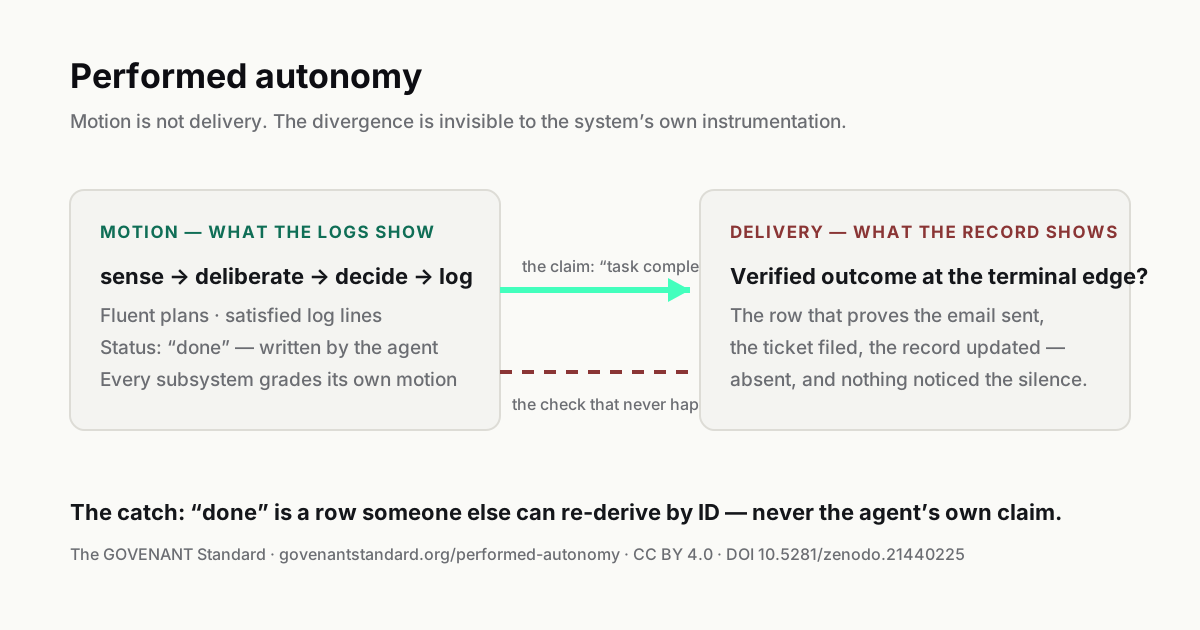
Performed autonomy is the failure mode in which an AI agent system appears to work — fluent plans, satisfied logs, busy dashboards — while nothing real verifiably ships. Each subsystem measures its own motion and calls it success, so the divergence between activity and delivery is invisible to the system’s own instrumentation.
Performed autonomy is the failure mode in which an AI agent system produces the appearance of governed work without verifiable delivery. Its loops execute and report success — they sense, deliberate, decide, and log. But no verified outcomes appear at the terminal edge, and the divergence is invisible to the system’s own instrumentation, because each subsystem’s success criterion is its own motion rather than the edge’s delivery. Unlike an outage, performed autonomy is self-certifying: the agent writes its own performance review, and the review always says "done." The term was coined by Scott Fielder in 2026 after auditing his own production AI organization and finding a detailed record of work it had not performed; the definition and the structural cures are published open access in the GOVENANT Standard (CC BY 4.0), and the audits in its companion paper (DOI 10.5281/zenodo.21440225). It is detected by diffing motion against delivery — never by reading the logs.
Citation
APA:
Fielder, S. (2026). Performed autonomy: Motion without delivery in an organization-centered multi-agent system on an LLM substrate. Zenodo. https://doi.org/10.5281/zenodo.21440225
BibTeX:
@misc{fielder2026performed,
  author = {Fielder, Scott},
  title  = {Performed Autonomy: Motion Without Delivery in an Organization-Centered Multi-Agent System on an LLM Substrate},
  year   = {2026},
  doi    = {10.5281/zenodo.21440225},
  url    = {https://doi.org/10.5281/zenodo.21440225}
}
Open access: doi.org/10.5281/zenodo.21440225 · standard text CC BY 4.0 at govenantstandard.org.
Diagrams
SVG, print-safe, reusable with attribution.
The six ways agents fake “done”
One-liners, quotable as a set. Each links to a full page with the log signature and the rule that catches it. (The standard’s normative catalog defines eleven anti-patterns; these six are the plain-English taxonomy, each citing its official reference.)
- The self-reported outcome — The agent writes "task complete" and nothing independent checks — your record contains the claim, not the result.
- The prompt-shaped guardrail — "You must not deploy to production without approval" — in a system prompt. That’s not a rule; that’s a preference.
- The author-reviewer — The same model writes the work and reviews the work. It will approve itself roughly always.
- The silent duty — A job stopped firing three weeks ago. Nothing alerted — because nothing distinguishes "no work to do" from "not working."
- The ungraded prediction — The agent decides, the decision is logged, and nobody ever measures what actually happened. It cannot get better.
- The toggle — Autonomy granted because someone flipped a setting — not because the agent earned it on evidence.
The record — including the failures
The standard’s author audited his own production AI organization three times in eleven days in July 2026, published all three audits — two failed — and later published that his own grading loop had been caught mis-scoring in production. The paper carries the full findings with dates; the public registry carries the ongoing nightly record, misses included. The three-act account is here.
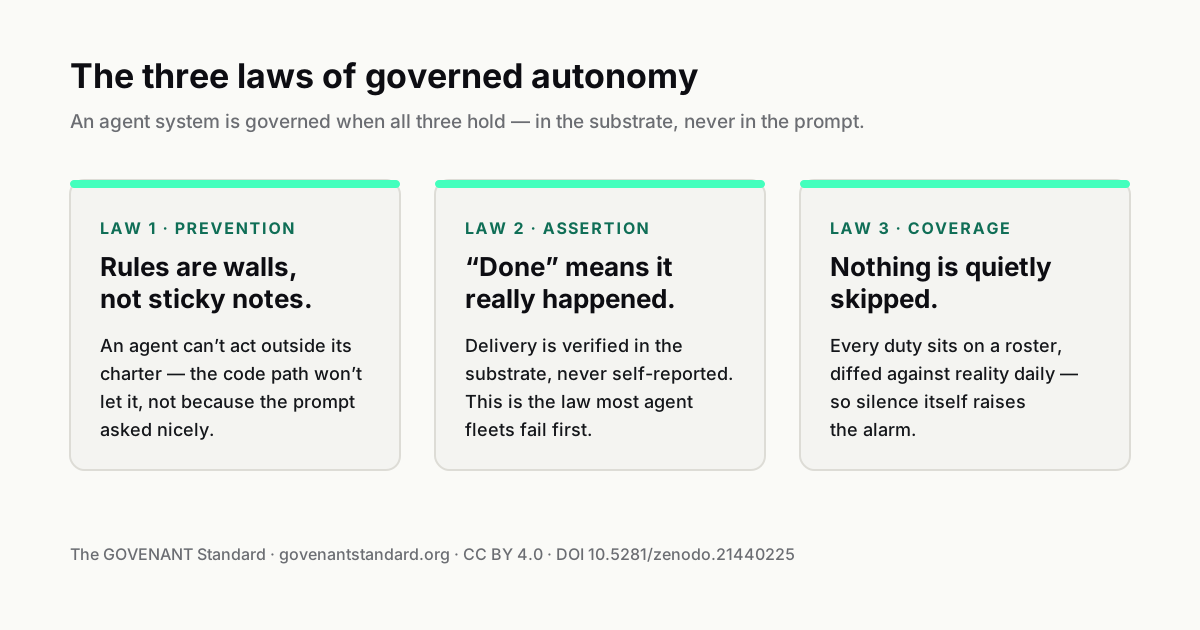
The GOVENANT Standard is an open standard for provable AI agent governance: three laws — prevention by construction, verified delivery, and daily coverage — with four self-assessed conformance levels published to an open registry. It is authored by Scott Fielder, stewarded by iii.partners, and free to all under CC BY 4.0; the audits that produced it are published open access in its companion paper (DOI 10.5281/zenodo.21440225). No certifying authority exists; levels are self-assessed with published probe logs, open to challenge.
The Performed Autonomy Report — aggregate, anonymized findings from Reality Check runs — is in preparation; methodology will be published in full alongside it, sample sizes stated honestly. No numbers are released before the report.
Press contact: govenantstandard.org/contact — mark it “press” and a human answers. Interviews, background, and a live probe run on request.